
Demystifying Your Rubber: The Ultimate Guide to Car Tires
Credit: Goodyear
No matter how many horses you have under the hood, how sharp your suspension is, or how massive your brake calipers are, your car only connects to the pavement through four patches of rubber roughly the size of your smartphone.
Tires dictate your vehicle's acceleration, cornering ability, braking distance, and overall ride comfort. Choosing the wrong set—or running a set into the ground—cripples your car’s performance and risks your safety.
1. Decoding the Sidewall: How to Read a Tire
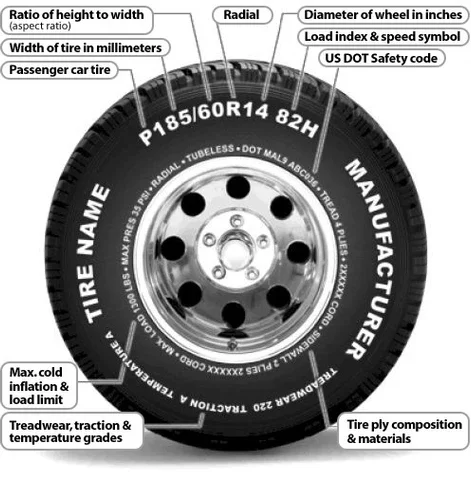
If you look at the side of any tire, you’ll see a complex sequence of numbers and letters. It looks like code, but it is actually a straightforward blueprint of the tire’s exact dimensions and performance limits.
Let’s break down a common enthusiast configuration, like 215/65R15 96V, using the labels you see on a typical sidewall:
215 (Section Width): The width of the tire from sidewall to sidewall in millimeters.
65 (Aspect Ratio): The height of the sidewall profile, expressed as a percentage of the width. Here, the height is 65% of 215mm.
R (Construction Type): Stands for Radial, which is the standard layout for virtually every modern passenger vehicle.
15 (Wheel Diameter): The diameter of the wheel rim in inches that this specific tire is engineered to fit.
96 (Load Index): A numerical code indicating the maximum weight capacity the tire can safely support.
V (Speed Rating): A letter indicating the maximum top speed the tire can safely sustain under its recommended load.
The Speed Rating Cheat Sheet
Enthusiasts pay close attention to the speed rating letter at the end of the sequence. Running a tire below your vehicle's factory performance capability can lead to sloppy handling or overheating at high speeds.
H: Up to 130 mph
V: Up to 149 mph
W: Up to 168 mph
Y: Up to 186 mph
2. OEM Replacements: Stick to Factory or Upgrade?
When a car rolls off the factory line, its suspension, steering, and braking systems are tuned precisely to a specific tire. These are called OEM (Original Equipment Manufacturer) tires.
Car manufacturers often spend millions developing custom rubber compounds with tire giants like Michelin, Continental, or Bridgestone to maximize a car's unique traits—whether that is fuel efficiency for a commuter car or maximum lateral grip for a sports coupe.
Sticking to OEM: Ideal if you love exactly how your car drove the day you bought it. Replacing your worn tires with identical factory-spec models guarantees consistent handling, fuel economy, and cabin noise levels.
Upgrading Aftermarket: If you use your car for spirited weekend drives, track days, or overlanding, upgrading past factory specs allows you to bias your car toward raw performance, heavy-duty durability, or extreme wet grip.
3. The Influx of "No-Name" Brands: Are They Safe?
A quick online search reveals dozens of new, unheard-of budget tire brands boasting impossibly low prices. While the low cost is tempting, running unknown, low-tier import brands can be a massive gamble for car enthusiasts.
How to Spot a Safe Budget Tire
All tires sold legally in the U.S. must meet basic Department of Transportation (DOT) safety standards. However, "legal" does not mean high performance. To distinguish a safe, affordable tire from a dangerous one, always check the UTQG (Uniform Tire Quality Grading) stamped directly onto the sidewall:
Treadwear Rating: A baseline number (e.g., 300 or 500). Higher numbers mean longer tread life, while lower numbers usually indicate softer, stickier performance compounds.
Traction Rating: Graded AA, A, B, or C. Avoid anything below an A rating for an enthusiast build, as this determines your car's straight-line braking ability on wet pavement.
Temperature Rating: Graded A, B, or C. This measures heat dissipation at high speeds. Performance cars should always run A-rated temperature tires to prevent catastrophic blowouts during heavy acceleration or sustained highway cruising.
Pro Tip: If you are on a tight budget, skip the total unknowns and look for reputable "second-tier" brands. Manufacturers like General (owned by Continental), Kumho, or Nexen deliver proven safety metrics, deep engineering data, and dependable warranties without charging premium tier-one prices.
Tire Sidewall Markings Explained. Source: Toee Tire
4. Mismatched Rubber: The Drivetrain Killer
It is incredibly common to see vehicles running a Michelin on the front right, a Goodyear on the front left, and random bald tires on the rear. While it saves money in the short term, running mismatched tires alters your vehicle's dynamics and can cause serious mechanical damage.
The Physics of Mixing
Every tire model uses a unique tread pattern and rubber compound that interacts differently with rain, heat, and torque. Mixing brands or tread depths across the same axle causes uneven grip. Under emergency hard braking or high-speed cornering, one side of the vehicle will break traction before the other, triggering unpredictable slides or premature ABS intervention.
Drivetrain Destruction (The AWD Tax)
If you drive an All-Wheel Drive (AWD) or 4WD vehicle (like a Subaru, Audi Quattro, or Jeep), running mismatched tires can cause catastrophic mechanical failure.
AWD systems rely on all four wheels spinning at the exact same speed. If you replace just one damaged tire with a brand-new one while the other three are halfway worn, the new tire has a larger overall diameter.
Diameter Variance -> Wheel Speed Discrepancies -> Center Differential Overheating
Because the older tires are smaller, they must spin slightly faster to keep up with the vehicle's actual speed. The car's computer or mechanical differentials sense this minor speed difference and misinterprets it as constant wheel slip. This forces the center differential or transfer case to work continuously to equalize power. Within weeks, this constant strain can overheat and shred your expensive drivetrain components, turning a simple tire issue into a multi-thousand-dollar repair bill. Always replace AWD tires in complete sets of four, or have a professional tire shop shave the new tire down to match the tread depth of the remaining three.
5. Knowing When It’s Time for a Replacement
Even if your car stays perfectly aligned, rubber degrades over time due to friction, heat, and environmental exposure. There are two primary ways to check if your tires are cooked: tread depth and age.
The Tread Depth Test
In the United States, a tire is legally bald and unsafe when the tread depth wears down to less than 2/32 of an inch. An incredibly simple way to measure this is the classic "Penny Test."
Take a standard penny and insert it upside down into your tire's tread grooves, with Abraham Lincoln's head facing you:
Safe: If the tread covers any part of Lincoln’s head, you have plenty of life left.
Time to Replace: If you can see the top of Lincoln's entire head, your tread depth is less than 2/32 of an inch. Your tires can no longer clear away standing water efficiently, skyrocketing your risk of hydroplaning.
The Hidden Danger: Tire Aging
Tires have an absolute shelf life, regardless of how much tread is left. Rubber dries out, loses its elasticity, and cracks from the inside out (dry rot).
Look for the DOT Code on your sidewall, which ends in a 4-digit number (for example, 2322).
The first two digits indicate the week of manufacture (23rd week).
The last two digits indicate the year (2022).
The Golden Rule of Tire Age: Any tire that is more than six years old should be inspected closely for dry rot, and any tire over ten years old must be replaced immediately, even if it has been sitting in a dark garage and looks brand new.
6. Finding the Right Set for Your Build
When it’s time to upgrade or swap your rubber, you need a source that offers massive inventory, clear performance testing data, and direct shipping to certified installers near you.
Whether you need ultra-high-performance summer compounds for track days, rugged terrain setups for an overland build, or dependable all-seasons for the daily commute, your best option is to shop through a trusted industry leader.
Head over to Tire Rack to plug in your vehicle's exact make and model, browse comprehensive real-world track testing reviews, and pick out a perfectly matched, safe set of rubber to transform your driving experience.